

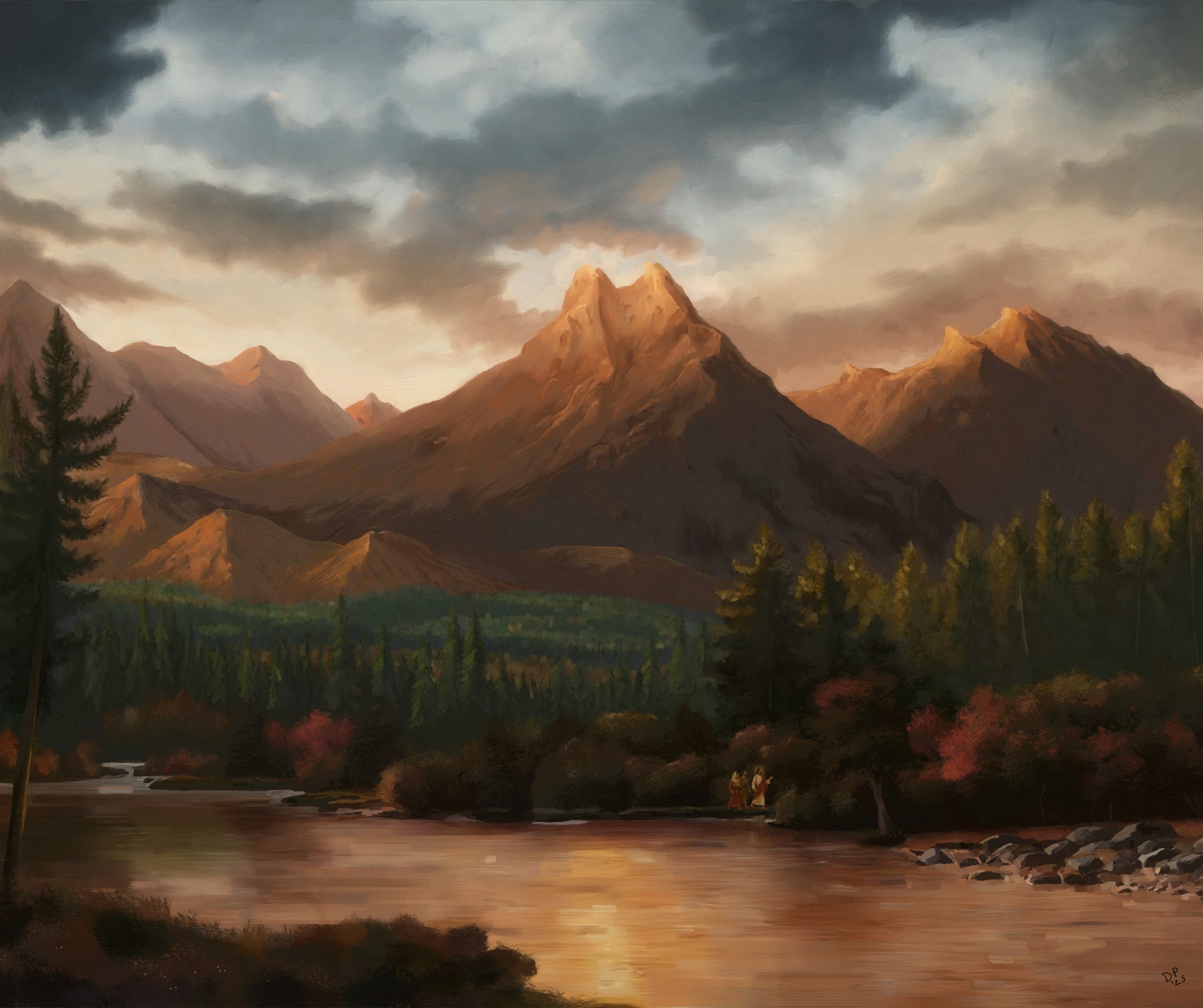
After eight years in this house, our dining room finally got its turn. For a long time it wore a coat of primer and leftover paint. We covered up the color from the previous owners, then seldom thought of it while we worked on other rooms.
As part of the makeover, my wife suggested it would be nice to have some kind of landscape painting in the room instead of another mirror. So I volunteered to paint one.
While it’s primarily a landscape, she also liked the idea of a subtle, Biblical element visible to anyone who looked closely. I liked that idea, too.
I’m not much of an artist. I’ve aspired to be. But in the way one aspires to have already done the work. The daily practice never called to me the way computer programming or writing does, where in boredom I’m quick to pick up either. But an old image kept visiting me: the home of a high school friend whose father was a painter. Every wall held one of his canvases. The house felt like a quiet gallery curated by a single soul. They were skillfully done and, in my opinion, transformed the house into a personalized gallery. It was a tasteful and unique portrayal of the artist who lived there. That memory has stayed with me. What a thing, to have lived among the fruits of a loved one’s creativity.
There’s a potential vanity in filling your own home with your own work, I realize. But I’d suggest that God Himself has surrounded Himself with His own beautiful creations, many of which are for His eyes only. No living man will ever see the farthest reaches of the cosmos, and those glimpses we do see are spectacular. As the only creatures made in the image of God, perhaps we have permission, maybe even a prerogative, to fill our own spaces with the beautiful fruits of creative impulses. I don’t begrudge my children for filling their rooms with crafts and drawings. The soulless alternative is worse.
My goals for the painting were twofold: First, it needed to belong in the room, and to complement with the new color. Second, I wanted a landscape, not an obvious Bible illustration. No ark on a mountain, no haloed figure front and center, and certainly nothing so grandiose as to render the hanging of my meager artistry a blasphemous statement unto itself. Just mountains, trees, water, and, if you look closely, a quiet scriptural nod.
So I worked up a scene of a mountain and a forest path running along the water’s edge. In that scene I placed three figures walking together. The first bears only a hint of a halo. The other two carry a soft glow at the chest, as if their hearts are lit from within. It’s a small homage to the Road to Emmaus.
The Road to Emmaus is a deceptively simple addition to Scripture, and a fascinating story both in content and in its inclusion in the gospel canon. The resurrected Christ joins two people (whom I’ve elected to interpret as a married couple) who walk with Him, and speak of Him, but do not recognize Him. Later on, once their eyes have been opened to the reality of the person with whom they spent their day and evening, they declare, “Did not our hearts burn within us!” The risen Christ was with them for miles, unrecognized and yet utterly Himself.
Luke 24:32
They said to each other, “Did not our hearts burn within us while he talked to us on the road, while he opened to us the Scriptures?” (ESV)
It is the privilege of believers in Christ to occasionally see, in retrospect, the work of the Lord amid difficult journeys. We are not entitled to such clarity, and should expect to go an earthly lifetime without seeing clearly the full work of the Lord. But from time to time, hard circumstances are revealed to have been mercies and blessings, moments at which the presence of the resurrected Christ cannot be denied… even if it was not recognized at the time.
I’m also struck by how the risen Jesus is both changed and still Himself. His own disciples fail to recognize Him at first. There is continuity: wounds, voice, ways of speaking and moving. But in the new life, there is also a difference that precludes immediate recognition.
C. S. Lewis once wrote that grace doesn’t erase our personalities but makes them most fully what they were meant to be. Like salt that brings out flavor rather than smothering it.
We experience this transformation spiritually now. And we will experience it physically when the resurrection comes. I can only imagine.
How I long to walk with the Lord, and how I long to recognize Him when I do.