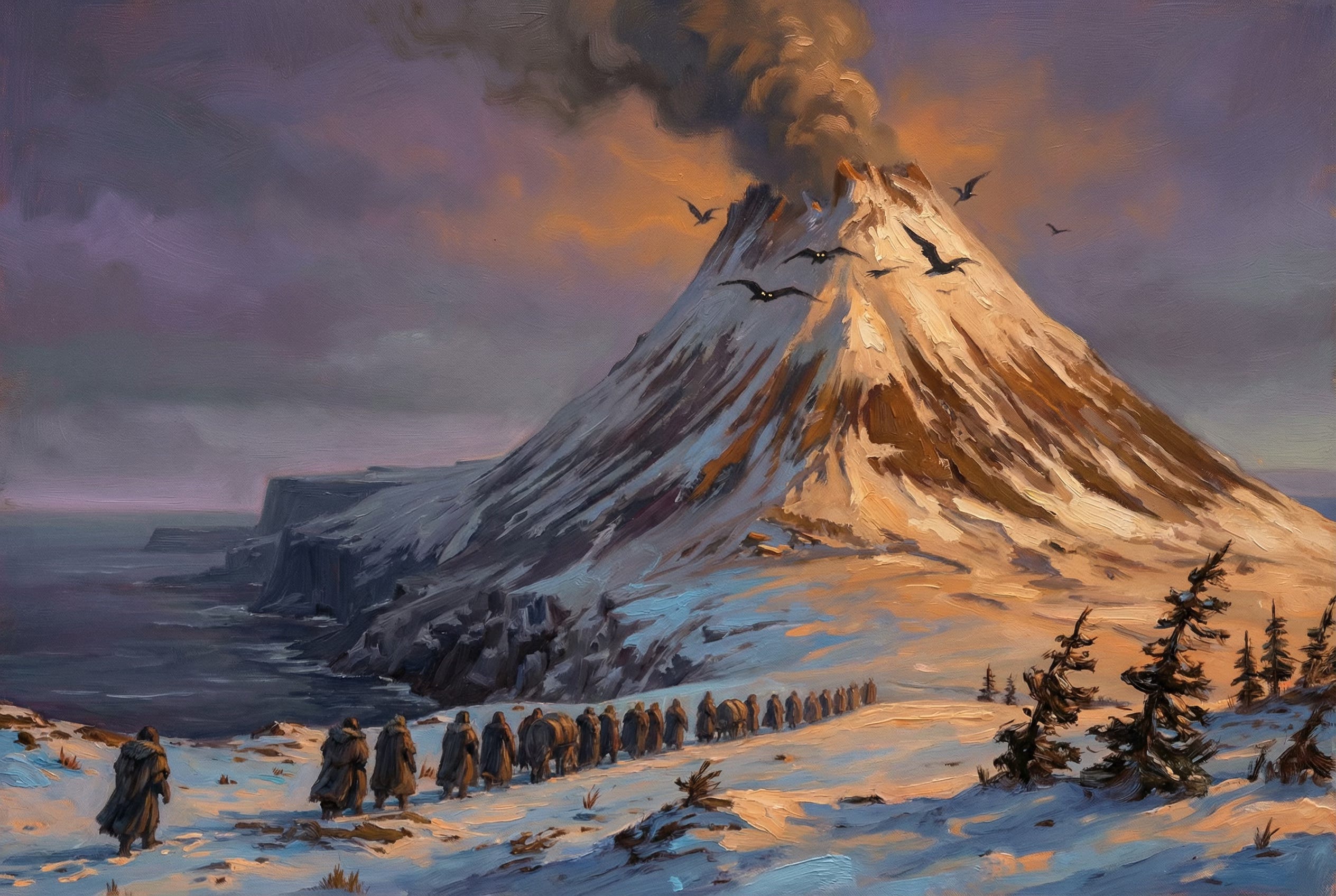
The mountain breathed smoke into a bruised sky. Snow fell in grey curtains, swallowed by volcanic stone before it could settle, but the cold lingered. It found the spaces between ribs. It pressed into empty stomachs.
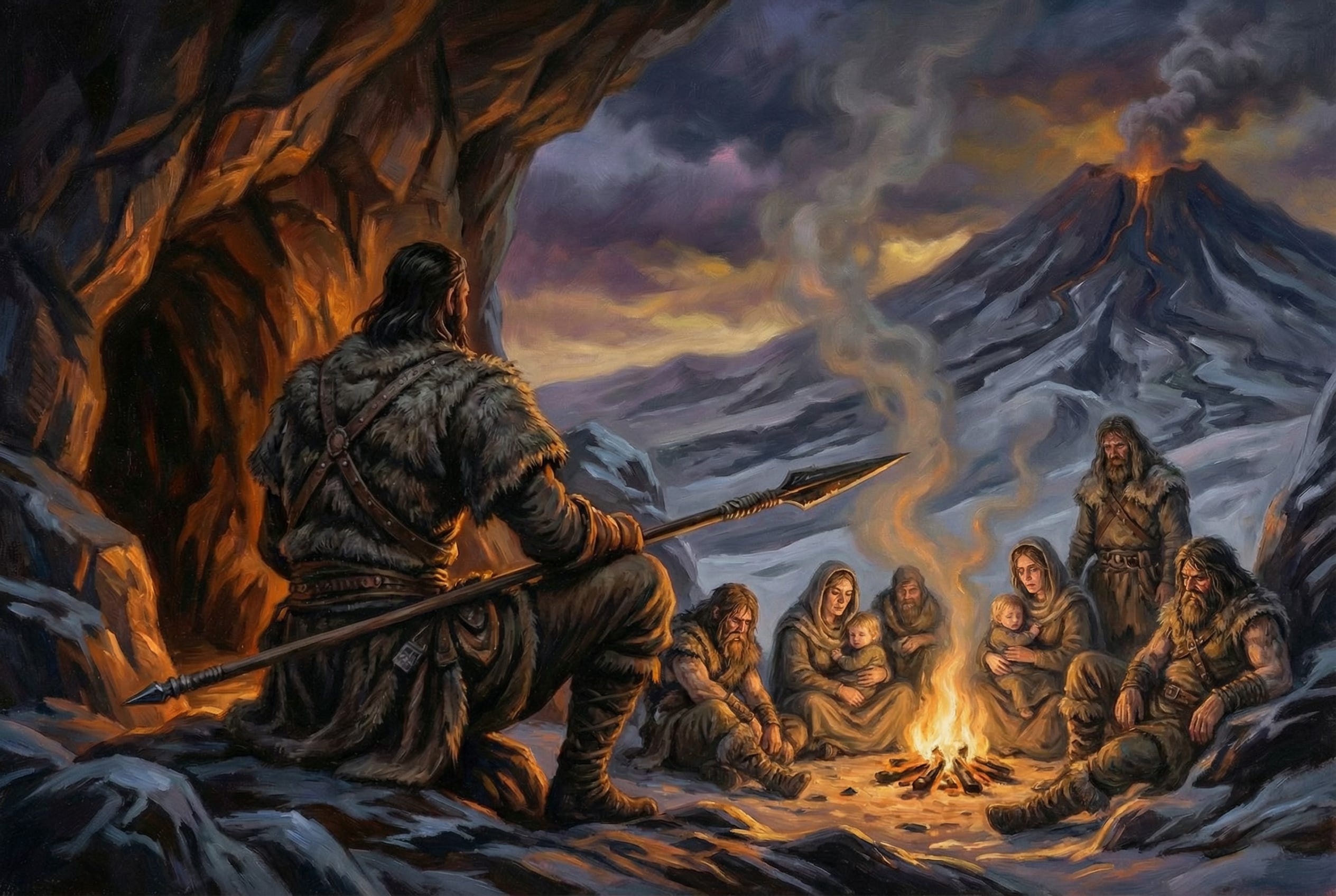
Thorgun stood at the mouth of the cave and watched the world disappear.
Behind him, the remnants of his clan huddled around a fire that gave less warmth each day. Fewer each morning than the night before. The firewood was green, scoured from stunted pines on the lower slopes. It hissed and spat more smoke than heat. The children had stopped crying two days ago. This was worse, far worse than the crying had been. A hungry child wails, but a dying child goes quiet. A dying child has already begun to leave.
They had fled lowland raiders three weeks past. His father—but no, he could not think of his father now, though the image came unbidden… the river crossing, the shallows turning red, the old man’s sword arm rising and falling until it rose no more.
Thorgun had led the survivors into the heights. He had not wanted to lead. He was merely twenty-six summers old, and a hunter, no less, not a chieftain. But his father’s body now lay in the lowlands, and none had stepped forward. So Thorgun led them into the mountains where raiders would not follow, into territory the lowlanders spoke of only in whispers.
Certain death dwelt upon the peaks of Ulvindra.
The cave stank of unwashed bodies, offal, and the animal musk of fear. Beneath these rose the slow rot that crept into wounds when there was no clean water. Old Margat’s leg had turned black below the knee. She would not survive the week. The youngest child had developed a cough that rattled like stones. Grandmother Rhunna sat apart from the others, humming to herself, her blind eyes fixed on nothing.
Thorgun counted the cured meat in his head once more. The same arithmetic he had run a hundred times. Only four days’ worth remained. Maybe five if they gave the children nothing. After that, the pack animals. After that… nothing.
He had heard stories of clans driven to such extremes that they looked upon one another with the eyes of predators, teeth turned to fangs by the pain of hunger.
He would not let his people sink to such dishonorable depths.
The sound of movement rose from the trail below: a figure climbing fast, surefooted despite the ice, something heavy across his shoulders. Thorgun’s heart lifted before his mind caught up. He knew that gait. He knew that reckless confidence.
Brant reached the cave mouth with frost in his beard. He was younger than Thorgun by four years, broader in the shoulder, quicker to anger and quicker to laugh. He had their mother’s coloring, dark where Thorgun was fair, and their father’s stubborn jaw.
He threw down his burden with pride.
“Meat,” he said. “And fresh. Enough for days.”
The clan gathered. Someone laughed, a sound not heard in weeks. Someone wept. Hands reached for the carcass, and Thorgun let them reach. Joy spread through his people. But his own stomach turned to ice.
The beast Brant had returned with was not hooved. Neither was it furred.
The creature was the length of a tall man, though much of that was neck and tail. Black scales covered its flanks, gleaming wetly. Leathery wings lay folded against its body, the membrane still thin and soft, not yet toughened by years of flight. Its head was long-beaked, crusted with blood where Brant’s spear had struck. The eyes, half-lidded in death, were gold—the color of amber held to flame.
A noxodon.
Thorgun had seen them circling the peaks, black shapes against grey sky, too distant to seem real. The elders spoke of them as one might speak of demons. Beings from the time before time, when the world was young and fire still ran freely through stone. They were never hunted. They were avoided, occasionally placated with offerings left at the treeline, and in desperation even prayed to when storms came down from the heights.
Now Brant had killed one.
“We eat well tonight,” Brant said, grinning.
Thorgun looked at the wings. They had never carried this creature above the clouds. The bones were still growing, the joints still soft. A child, perhaps.
“What have you done?”
Brant’s grin faltered. “I’ve fed us, brother. I’ve climbed higher than anyone else dared, found fresh prey fit for our clan, and brought it back. Our children starve. Why do you question it? You should thank me.”
“The noxodon do not forget.”
“Superstition. The noxodon are beasts.” Brant kicked the carcass. “Large beasts, yes, but beasts all the same. They hunt. We hunt. Today we were better hunters. Look at it. Scales and wings and nothing more. It bleeds. It dies. It feeds hungry mouths.”
Thorgun looked up at the peak, where larger shapes circled in the haze. How many were there? The elders had always said the noxodon numbered in the hundreds, that they had laired in these mountains since before the clans dwelt on the earth. And the noxodon remembered everything. They held grudges across generations. They knew the scent of those who wronged them.
Thorgun said nothing. Brant knew as much already.
The meat was already being butchered, scales pried off by eager hands, flesh divided among the hungry. His people were already eating, faces awash with relief, and gratitude, and the simple pleasure of famine abating. Who was he to deny them this? Who was he to speak of consequences when children sat with food in their mouths for the first time in weeks?
That night they slept with full bellies. The fire burned brighter, fed by fat rendered from the carcass. Children curled against their mothers, no longer crying, no longer silent with the silence of the dying. Even old Margat seemed stronger, though her leg still wept black into the bandages.
But Thorgun could not sleep.
He sat at the cave mouth with his spear across his knees and watched the sky.
She arrived at dawn.
Gray light crept over the eastern peaks. Mist rose from the volcanic vents, mingling with falling snow, erasing the world’s edges. Thorgun had dozed despite himself, chin dropping to his chest, grip loosening on the spear.
He woke to a silence deeper than snowfall alone could bring.
The birds had stopped singing. The wind had stopped blowing. Even the fire had fallen quiet.
Her shadow fell across the cave before he saw her.
The morning sun vanished. The temperature plummeted deep beyond the winter cold, something that belonged to tombs and the spaces between stars. His people woke screaming.
The mother landed on the ridge above them with a sound like the mountain being sundered.
She was vast—many times the size of any noxodon Thorgun had glimpsed circling the peaks. Her scales were the deep, pitted black of ancient iron, drinking the light and giving nothing back. Her wings blotted out the sky, leathery membranes stretched between bones thicker than tree trunks.
But Thorgun could not help but meet her eyes. Her terrible eyes. They were twin points of cold, pitiless fire, fixed on the cave mouth with purpose and vengeance. She had seen the bones piled by the fire. She had smelled her child’s flesh on their breath.
The clan scrambled for weapons, for children, for each other. Brant seized his spear and pushed to the front, shouting glory. The other hunters formed a ragged line. Their faces were pale, and their hands were trembling. Fighting raiders and wolves was one thing. This was something else. They raised their weapons all the same.
Thorgun stepped past his brother and the line of hunters. Past the last boundary between his people and their death. Each step felt like walking into deep water, the pressure building against his chest, his breath coming shorter.
He carried no weapon. He raised no hand. He walked forward, into the shadow of the queen.
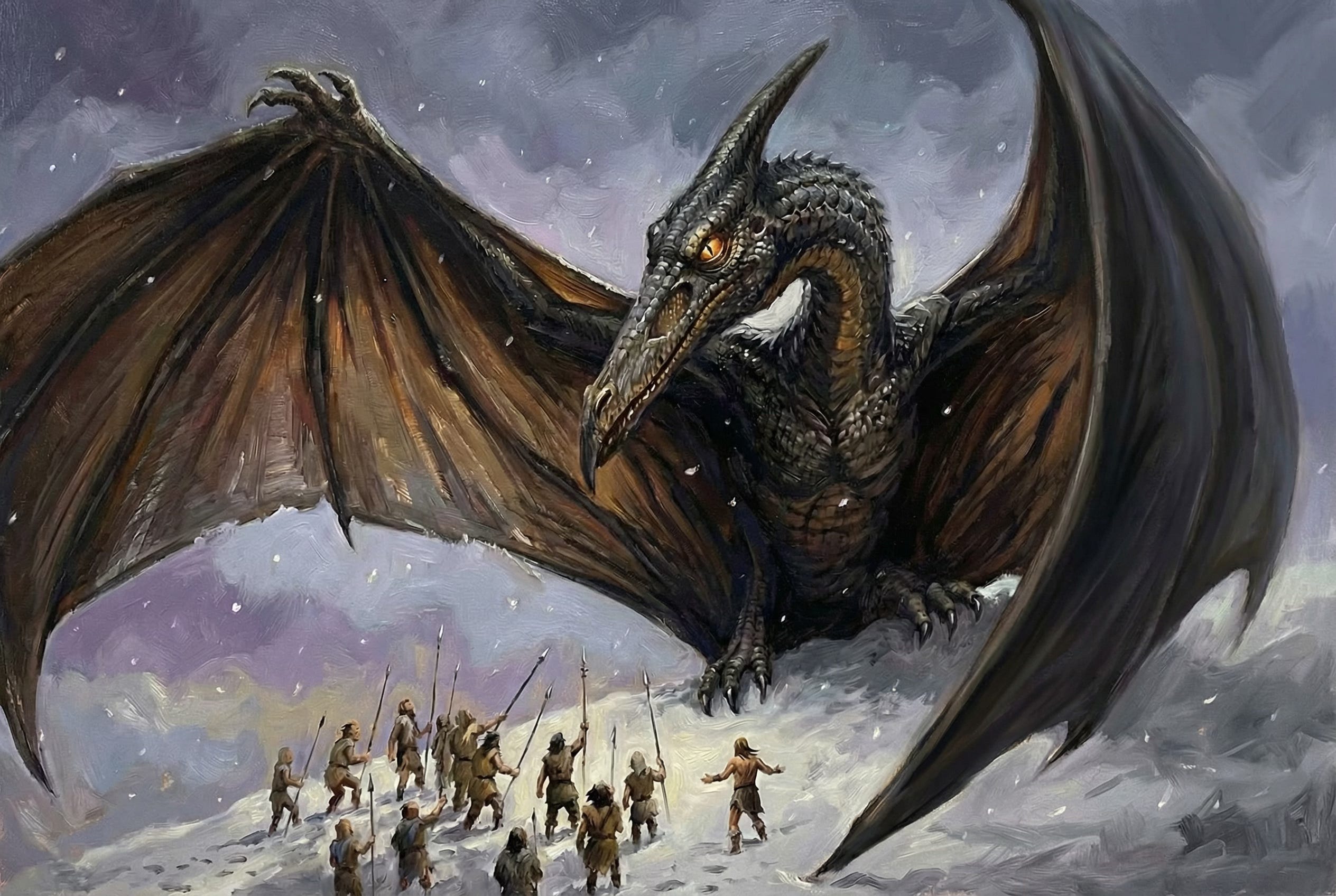
He stopped at the edge of the ridge. The wind had returned, carrying sulfur and char and the rarified air bred by storms: the breath of the mountain itself. He looked up into her eyes and spoke.
“If blood is owed, take mine.” His hands hung open at his sides. “Spare the others.”
His voice did not shake.
“What are you doing?” Brant’s voice cracked between whisper and shout. “It’s going to kill you!”
The mother of the noxodon spread her wings. Shadow swallowed the cave mouth, the ridge, the sky itself. Her talons gouged the stone as she lowered herself toward them.
She regarded him with eyes made for flames. With her gaze came weight and pressure, as though her attention alone might crush him into the snow. Then something entered his thoughts. Not words. Meaning.
You killed my child.
Thorgun could not deny it.
“Please…” he stammered.
There is no please. There is only ending.
The shadow deepened. The weight in his mind became agony, a vice closing around his skull. Thorgun’s knees buckled. He thought of his father at the river crossing. He would see him soon.
Then a voice rose behind him.
Rhunna was ancient. The oldest of the clan, half-blind and bent nearly double by her years. She had outlived more kin than she could count. The young men carried her when the clan moved. She had not walked unaided in five winters. Most thought her mind had wandered into the fogged lands where ancestors dwelt. Rumor was that she spoke more to the dead than to the living.
Now she was singing.
Her bearer had carried her forward, toward this queen of fel beasts, and there Rhunna had slipped from his arms. She crawled the last few paces on hands and knees, joints cracking, breath rattling—dragged herself toward the very jaws that would kill her. And she raised her head and sang. A lullaby. The melody was already old when her own grandmother was young. She had sung it to Thorgun’s father when he was small, and to Thorgun after that, and to every child of the clan who could not sleep. This wordless tune. This mother’s song. Sung now to a beast that had come to slaughter them all.
The pressure in Thorgun’s mind vanished.
The queen went still. Not the stillness of a predator tensing, but something else... A frail woman, crawling toward certain death, offering comfort all the same. Her burning gaze found Rhunna, and the fire in them shifted. The rage did not vanish. But beneath it, older and deeper, rose a question.
New images flooded through like a waking dream.
A nest high in the mountain. Heat rising from the stone. The smell of sulfur and shell and living warmth. Dozens of eggs crowded the hollow, pale and pulsing. Noxodon mothers circled above, restless even in tending, their blood burning with the need to hunt. They could not be still. They were not made for stillness. Their hunger drove them to the sky.
The vision lurched. The nest half empty now. A shell gone cold under his palm. The feel of it, smooth and dead as river-stone. A crack splitting the silence. A hatchling too weak to push through, its cries thinning to nothing. The stench of an egg gone dark. Fewer mothers each generation. Fewer wings overhead.
Now the nest was nigh empty. The queen alone where dozens once circled. She was the last who could still lay, and she could not tend and hunt both. The stone still breathed heat beneath the shells. But warmth without presence was not enough. Her children had needed hands. Voices. Lest the brood die in its pride.
She had come to kill. She could still kill. But she showed Thorgun what killing would buy her: nothing. His people would die in the winter regardless. Her vengeance would be complete and hollow, and her eggs would grow cold, and her kind would end. She had watched humans for hundreds of years from the heights. She had seen them as prey, as pests, as things beneath notice.
But she had never seen one crawl toward death to sing comfort.
Uncertainty hung in the air for what felt like centuries. Rhunna sang. The hunters awaited an order, bracing for the end.
At last, the tension broke, and the vision continued. She showed Thorgun what she offered: warmth channeled through the mountain’s heart, protection from above, and a place to endure. And she showed him the price. One egg, always, kept warm by human hands, human voices, and human presence. His people would be bound to the mountain. His bloodline would be sworn to her service. Not in friendship, nor trust. But in obligation, sealed in the blood his brother had spilled. A covenant forged from necessity and grief that would bind man and beast until fate could be staved off no longer.
Thorgun sank to his knees. Cold seeped through hide and wool. The weight of generations settled upon his shoulders; those past and those yet lived. To what he might bind them, he could not fathom. He was accepting for his children, and their children, and all who would come after.
“We accept,” he said, bowing his head. “My queen, Azythra.”
The words hung in frozen air. For a moment the clan murmured in confusion. But then, they fell silent. Even Brant lowered his spear.
Azythra bowed her head and spread her wings. The shadow deepened, vast and cold, then lifted as she rose. The sun broke through at last, casting golden light across the snow.
She turned toward the peak.
Follow.
Azythra led them up the mountain until darkness fell.
All the clan followed. The hunters with their useless spears, the women carrying the youngest children, Rhunna on her bearer’s back, still humming faintly, eyes half-closed. Even Brant followed, clutching his weapon, scowling. Every so often he caught a glimpse down through the mist, toward the grey lowlands where the rivers ran to salt water and a man might breathe without bowing to beast.
The clan climbed paths no man had ever dared walk. They shimmied across narrow ledges carved by volcanic flows and crept through tunnels that breathed strange air from the mountain’s depths. Steam rose from fissures in the rock, and the air grew warm with the breath of the mountain.
Eventually, the cold sloughed away like a shed skin.
A few noxodon watched from the ledges above, their eyes like guttering embers in the dark. They tracked the procession of small prey climbing into their domain.
The queen led them to a shelf of stone high above the clouds, and there the mountain revealed its heart. Heat breathed from the rock, steady and patient, the warmth of embers banked since the world was young. Moss grew here, soft and fierce green, the first living color Thorgun had seen in weeks. A spring of clean water whispered from a fissure in the stone, steam curling into the thin air.
The clan spread across the ledge in silence. They touched the warm stone with trembling hands, flinching as though it might burn or vanish. No one wept. Not yet. They had lived too long inside the certainty of death to trust its sudden absence. Mothers held their children close, not lifting them toward the heat but shielding them from it. A few sat with their backs against the rock and their eyes on the sky, waiting for the blow to fall.
Brant alone did not sit. He stood at the ledge’s edge with his spear planted, watching the noxodon that perched on the crags above. He did not touch the warm stone. He did not feel an ounce of gratitude for the mountain’s heat.
The queen descended.
In her talons she held an egg.
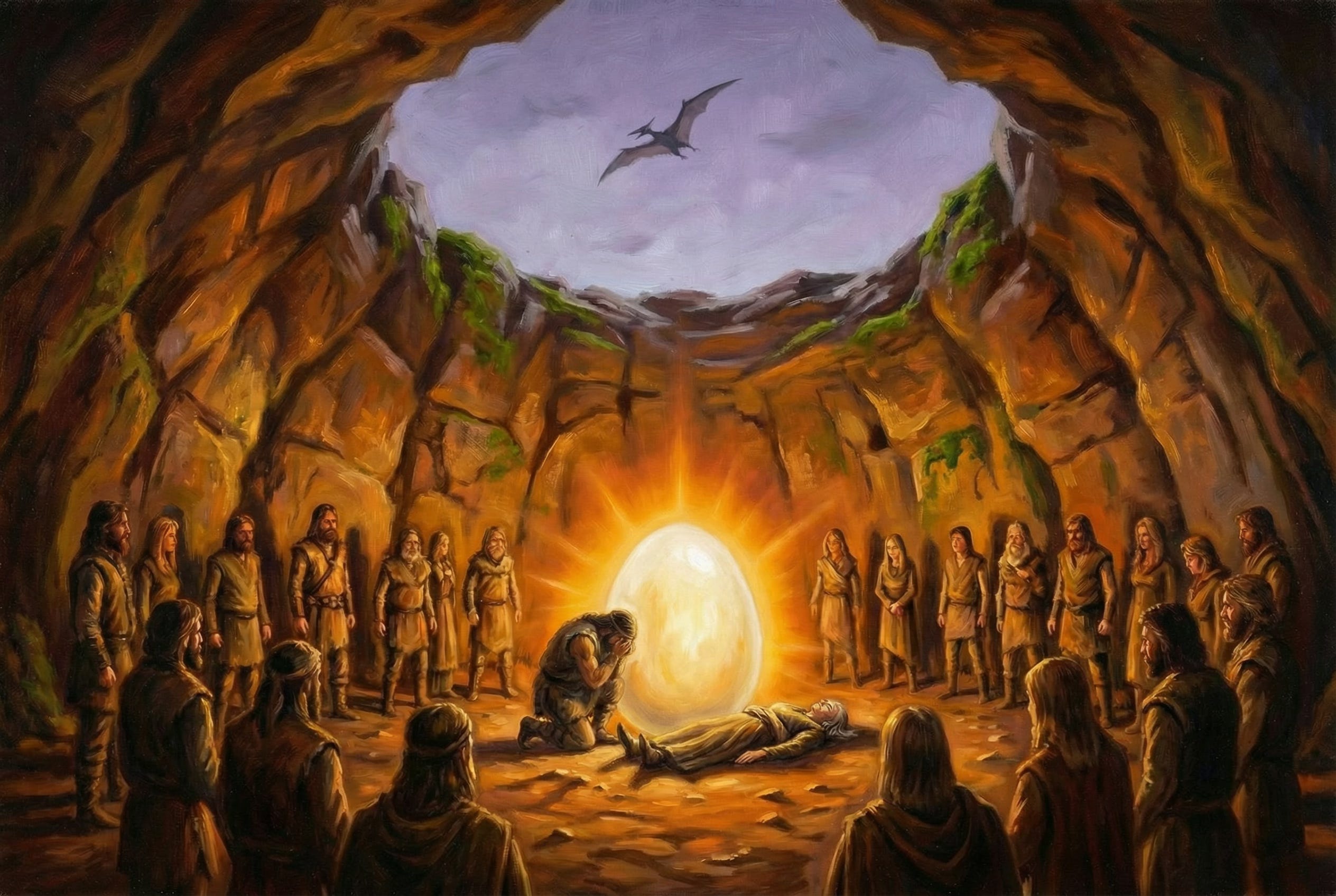
The egg stood taller than a man, pale as moonlight on snow, and within it burned a glow that pulsed like a living heart. Its shell held warmth the way embers hold fire—patient, ancient, and waiting. Something stirred in that light: a shadow turning, slow and vast. She set it before Thorgun with the tenderness of a mother placing her child in another’s arms.
The light reflected in the eyes of his people. The starving, freezing people he had led up a mountain to die. They were warm now.
Rhunna pushed herself from her bearer’s back. The young man tried to stop her, but she waved him away. She dragged herself to where the egg rested, joints creaking, breath coming in shallow gasps. So terribly, desperately frail. The effort alone might kill her.
She curled herself around the shell, pressed her thin frame against its glowing surface, and began to sing the lullaby again.
“Grandmother,” Thorgun said. “Let someone else.”
“No.”
Her voice was firm. It was the voice of the woman she had been before age withered her.
“I have buried many children. Let me keep this one warm.”
She sang through the night.
Dawn found her still singing, her voice worn to a whisper but unbroken. The egg pulsed brighter with each verse. Someone pressed water to her lips—she drank between breaths, never letting the melody falter, as though the song itself had taken root in her chest and would not be silenced.
She sang through the second night.
Her voice cracked and wandered, losing the tune, finding it again. But the egg’s glow continued to spread through the chamber, casting soft, yet growing shadows on stone.
On the third night, her voice failed entirely.
She kept humming. A thin rasp, barely audible, but constant. Then even that stopped.
Thorgun found her in the morning.
She lay curled around the egg as though asleep, her thin arms wrapped around its shell. Her face was more peaceful than he had ever seen it, more peaceful than it had been since his grandfather died. Her skin was cold. But the noxodon egg beside her was warmer than ever.
Her final breath. Her final warmth. Her final song. She had given everything she had left to give.
The clan gathered in silence. They had no words for such a sacrifice.
And in the silence that followed, Thorgun could have sworn he heard her voice still hanging in the cold air… a wisp of melody, thin as frost.
Brant broke the trance.
“She gave her life for an egg.” His voice was scraped raw by grief. He stood apart from the mourners, spear still in hand, his dark eyes fixed on the glowing shell that held the shape of Rhunna’s embrace. “A beast’s egg. And you kneel.”
No one answered. The words hung in the air.
“Our grandmother is dead. She sang herself to death for a creature that would have killed us all yesterday morning… and still might! And now you would bind our children, and their children, and their children’s children to this mountain forever? As nursemaids to reptiles? Servants to a beast who showed us mercy only because she needed my grandmother’s final warm breath.” He looked at Thorgun. “I love her too, brother. That is precisely why I will not accept this. There is land below. Coastline, and timber, and game that bleeds red and does not fly. I would sooner take my chances with the raiders than follow your foolery.”
Thorgun looked at his brother for a long while. He wanted to argue. He wanted to say that Rhunna had chosen freely, and that her death was not the covenant’s price but its foundation stone. But the words tasted false. Brant was not entirely wrong.
“The choice is made,” Thorgun said. “Those who wish to go may go.”
Silence held the chamber. Then movement.
A hunter near the back rose first, pulling his cloak around his shoulders. Then a woman with a child on her hip. Then two more hunters, young and hard-jawed, men who had followed Brant since the lowlands. A family of five. An old man who had never trusted the mountain’s warmth.
They gathered behind Brant. Not many. But enough to wound. Enough to thin the firelight, to leave gaps in the circle where bodies had been.
The two brothers faced each other across the diminished chamber. Brant opened his mouth as though to speak again, then closed it. There was nothing left to say that would not draw blood.
He turned and led his people down the path they had climbed.
Thorgun walked to the ledge’s edge and watched. The small band of his brethren wound through the mist, growing smaller with each switchback. Torchlight and shadow, the shape of his brother’s broad shoulders, the spear held upright against the grey sky. They passed below the cloud line and were gone.
He stood there long after the last light vanished. Wind pressed against him, carrying sulfur and the memory of snow. Somewhere far below, the mountain gave way to foothills, and the foothills to the flatlands, and the flatlands to the sea. His brother would find that coast. He would build there, at the foot of the mountain, within sight of the peaks but free of their burden. And his children would look upward and remember what their father had refused.
It was the last time the brothers would stand upon the same ground, and neither of them had known it until it was past.
Thorgun looked at the egg, then to his grandmother’s face. He could not bring himself to look upon the people who depended on him. He was their chieftain, bound by covenant to a creature who had watched the world grow from its youth, responsible for a bargain that would outlast everyone in the chamber.
He knelt beside her body. The melody was there, placed in his memory by her voice when he was too young to understand words. His throat was tight. His eyes burned.
Then Thorgun began to sing.
His voice was unsteady and unpracticed, nothing at all like Rhunna’s. But the tune formed nonetheless. The egg’s glow pulsed in response.
One by one, those who remained joined in.
The high voices of the children threaded through the deeper tones of men, red-faced and off-key. The women carried the melody. But there were gaps. The sound was thinner than it should have been. Even so, the singing filled the chamber, echoed from the warm stone walls. Though rough and unpolished and diminished, Rhunna’s lullaby pleased Azythra nonetheless.
Had he done the right thing? His children’s children would be bound to this mountain, to this egg, to the queen who watched from the heights. Not for a winter. Not for a lifetime. For generations beyond counting. Blood had opened the door, and blood had sealed the covenant and severed the clan.
Two bloodlines made one. One bloodline made two. The price was only beginning, and there was no telling what Queen Azythra would ask of those who remained… or when death might finally find them.
But the choice was made.
The egg glowed.
And his people were warm.
And the song did not stop.
It would not stop for eight hundred years.
🌋 Valen the Rogue and the Arcane Awakening
The next Valen the Rogue novella is right around the corner. Instead of buckling down and concentrating on finishing it when I intended to, I decided to distract myself with more (albeit tangentially related) writing.
Turns out writing an even shorter story isn’t actually that much easier. It’s just a bit less to keep track of day-to-day.
This text will likely be printed in the paperback edition of Valen the Rogue and the Arcane Awakening. But it will remain free to read here, as well.
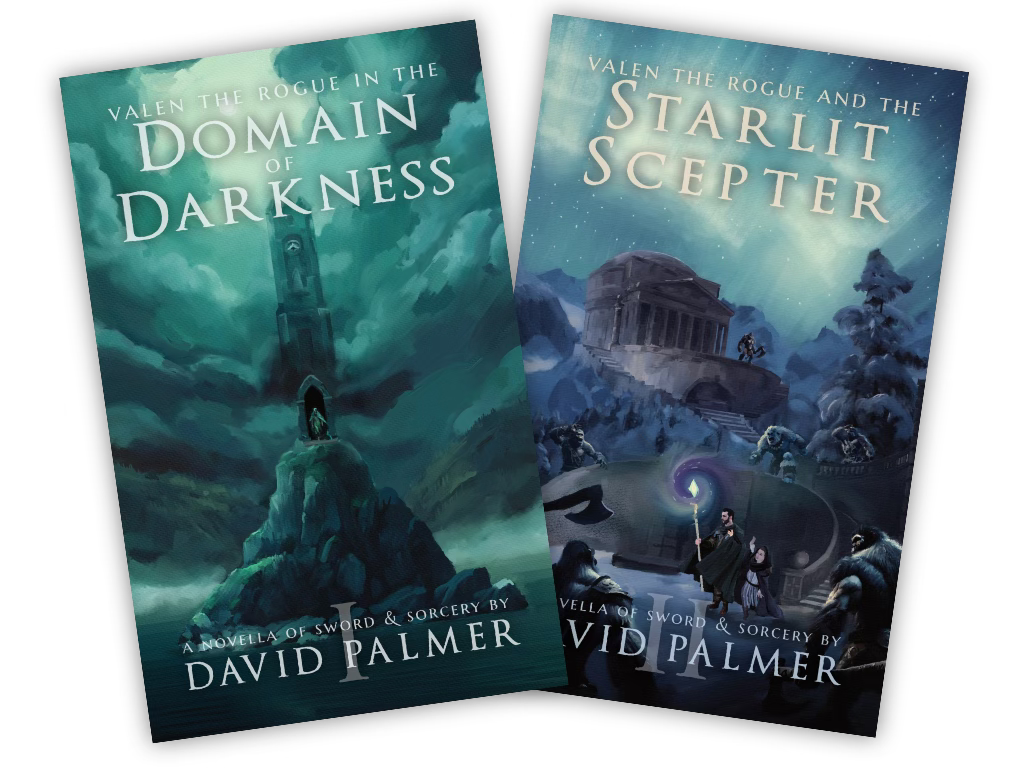
If you enjoyed this story, I would be appreciative if you checked out my two currently published novellas, too. They’re available as eBooks and paperbacks on the ‘zon.